
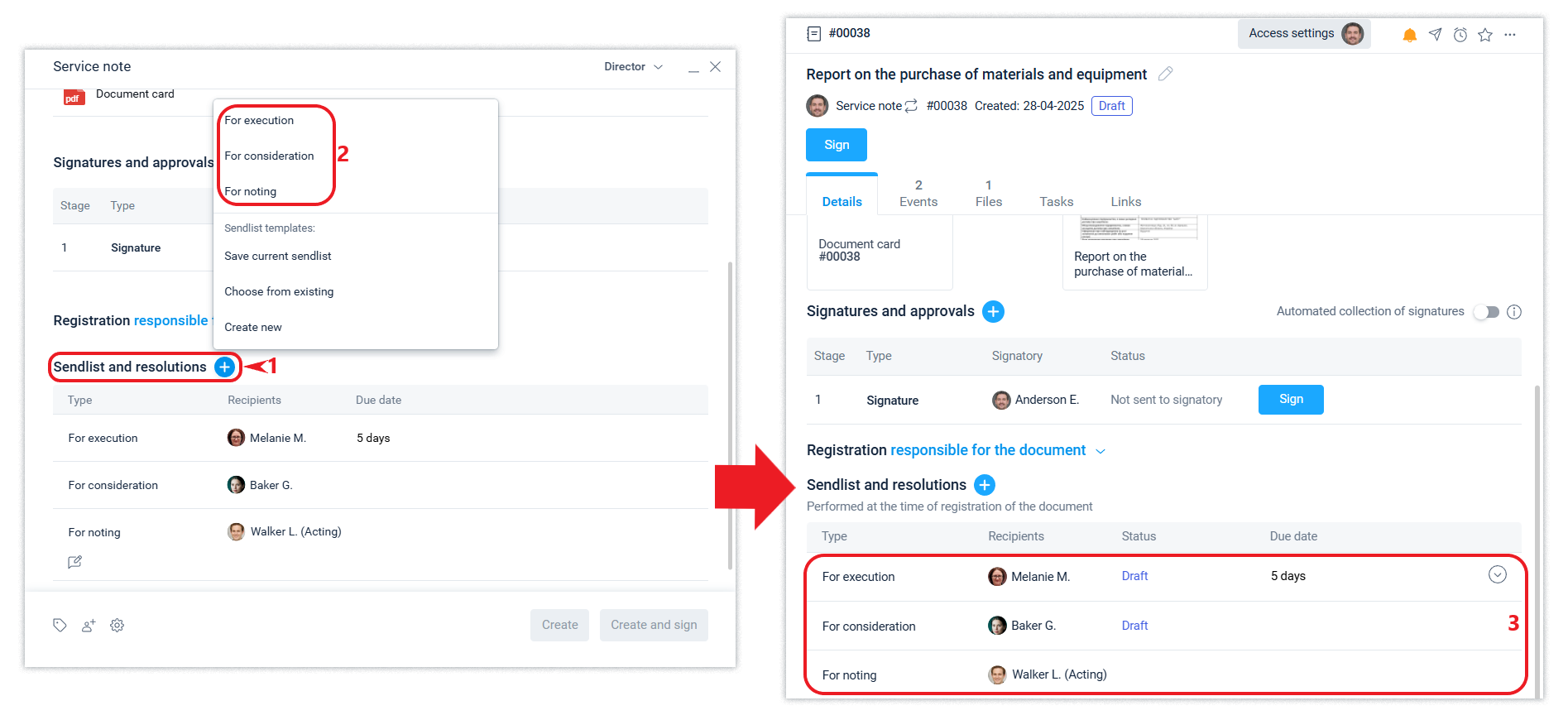
At the time of registration, the document is sent to the employees or external counterparties specified in the document sendlist. Before registering a document, the author of the document must identify those to whom it will be sent upon registration.
The sending is performed on behalf of the person who signed the document. If there are several signatories, then on behalf of the last signatory.
A document template may contain so-called ‘hard’ attributes that cannot be deleted or changed in the created document instance.
The distribution cannot be repeated, even after returning the document to the Registration status or opening it for editing. If you need to perform an official distribution of the document, rather than simply opening it for access, you can use the Send document action, and then the recipient will be transferred to the Distribution and resolutions block in the Additional distribution and resolutions section.
Types of sendlist
The “For noting” sendlist: Stay informed without extra effort
This type of mailing list is ideal for informing colleagues about documents that do not require immediate action on their part.
-
Purpose: Simply to keep the team informed.
-
How it works: The recipient receives a notification and access to the document. The system records that the document has been viewed, but does not create any tasks.
-
Result: The team is synchronised, and the workspace is not cluttered with unnecessary ‘tails’ in the task lists.
The “For consideration” sendlist: Working with resolutions
This type of distribution is designed to convert an incoming document into specific actions. It is most often used when a document is sent to a manager for decision-making.
How it works in simple terms:
-
Automatic task: When you send a document ‘For review,’ the system automatically creates a task for the recipient. This is a signal: ‘You need to look at the document and decide what to do with it next.’
-
Freedom of action: The recipient decides the fate of this task. As soon as they create a Resolution (their decision on the document), the task is automatically considered completed and closed.
-
Result of the resolution: With one click, the manager can forward the document: For execution (give a specific assignment), For information (just to inform colleagues) or For consideration by the next chain of managers.
The ‘Manager + Assistant’ tandem: We know how valuable a manager's time is. That is why Schrift has implemented a convenient resolution draft feature:
-
An assistant can prepare a draft decision in advance.
-
The manager only needs to review the draft and confirm it with a single click.
-
This eliminates routine tasks and allows the manager to focus solely on making decisions rather than filling out forms.
Best practice: For incoming documents or internal memo, the ideal scenario is registration with immediate forwarding to the manager ‘For consideration’. This ensures that no letter is left unattended and with clear instructions for action.
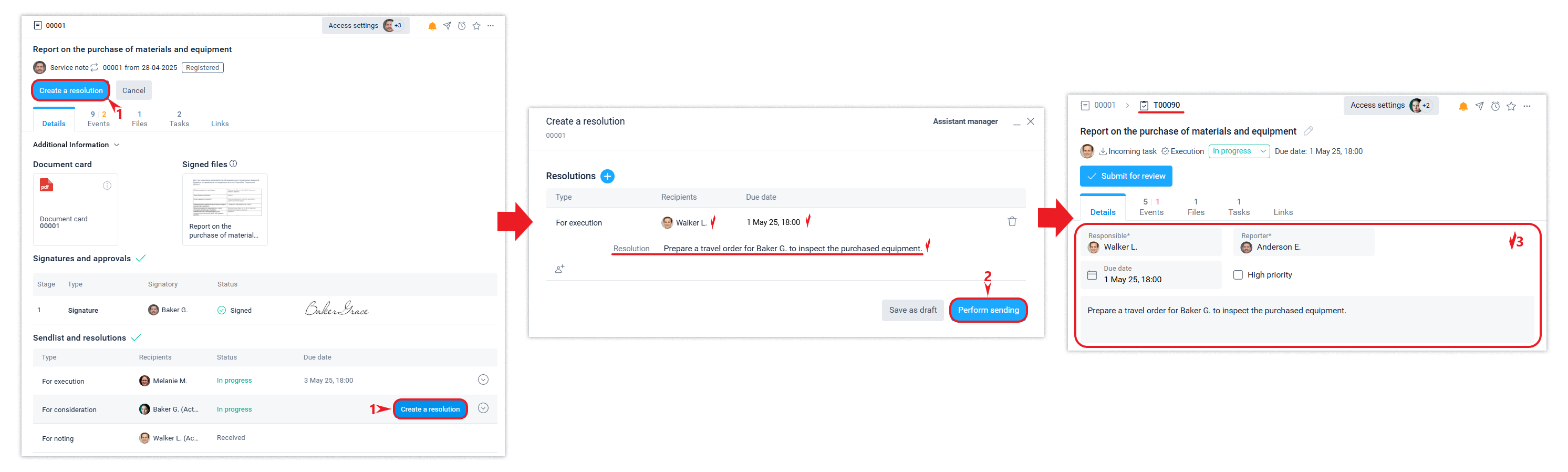
‘For execution’ sendlist: Responsibility and control
This type of sendlist turns a document into a specific assignment. The system automatically creates a task with all the details already specified: subject, deadline, creator, and person responsible.
Who becomes the reporter? Usually, it is the signatory of the document. This is logical: whoever gave the document legal force is responsible for its implementation. However, any other employee may be specified as the reporter in the sendlist.
Smart subordination (control of rights): If your company has set up task assignment rights (‘who can give assignments to whom’), Schrift closely monitors compliance with the rules:
-
Automatic launch: If the signatory has the right to assign tasks to the person responsible, the task is launched immediately after registration.
-
Protection against ‘self-activity’: If there is no direct right to assign a task, the system will not block the process, but will simply ask for confirmation. This ensures that no task will appear in an employee's plan without their manager's knowledge.
-
Change control: If, after the document has been signed by the manager, someone decides to change the deadlines or the composition of the executors in the distribution list, such a task will also require re-confirmation. This protects you from situations where ‘the deadline has been quietly moved to yesterday’.
Result: Everyone knows what to do, and management is confident that all tasks are legitimate and in line with agreements.
Sendlist templates
For convenience and time savings, you can customize document sending using templates. The system user can create a personal document sendlist template or use publicly available templates created by other employees.
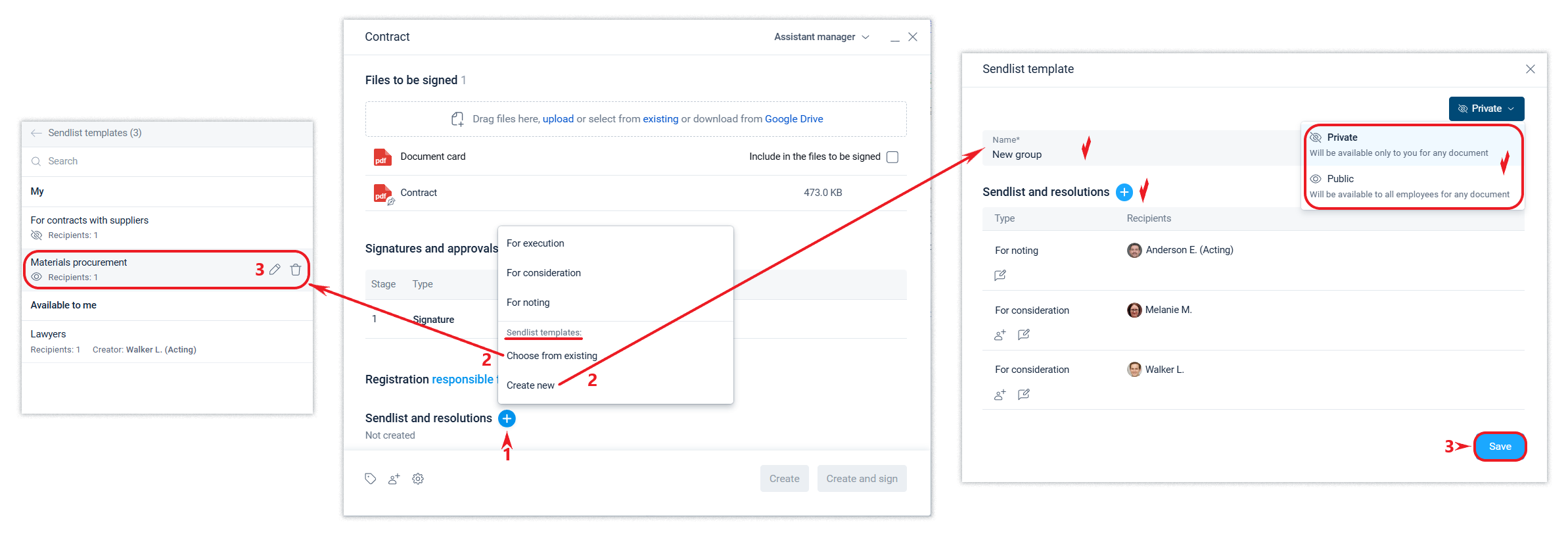
You can also create a new mailing template based on any document mailing in the Sendlist and Resolutions section on the right side or when customizing a document template.
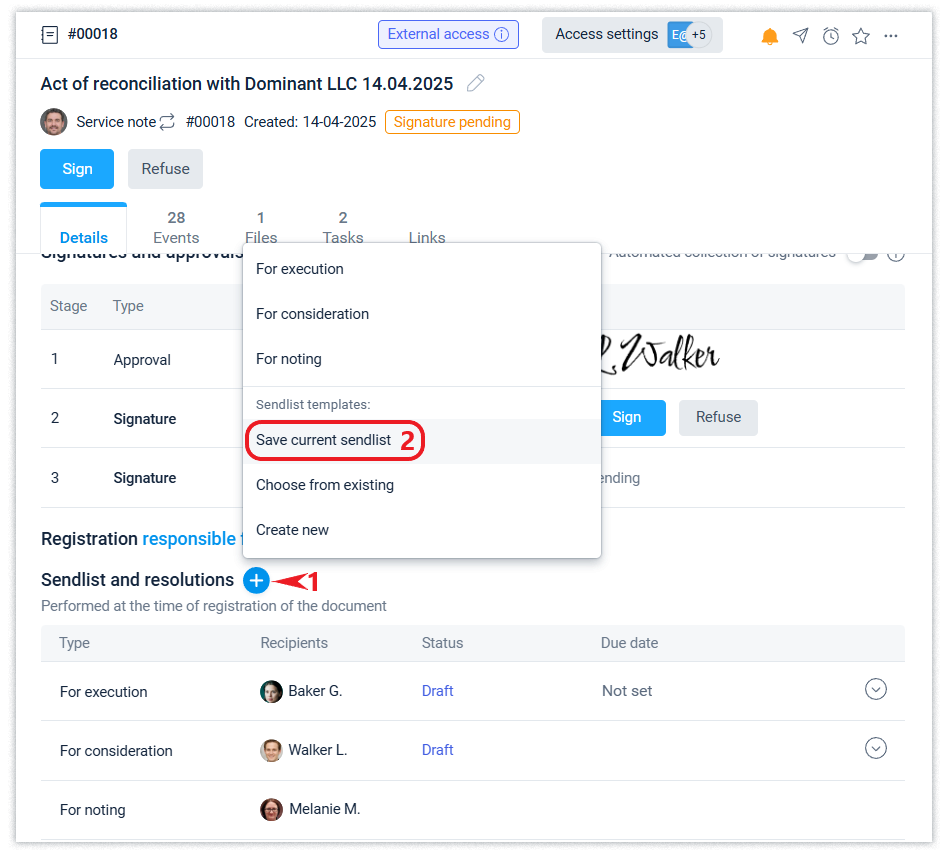
You can use sendlist templates that have already been created when sending messages, sending a document for group signature, etc. by selecting the desired group of recipients.
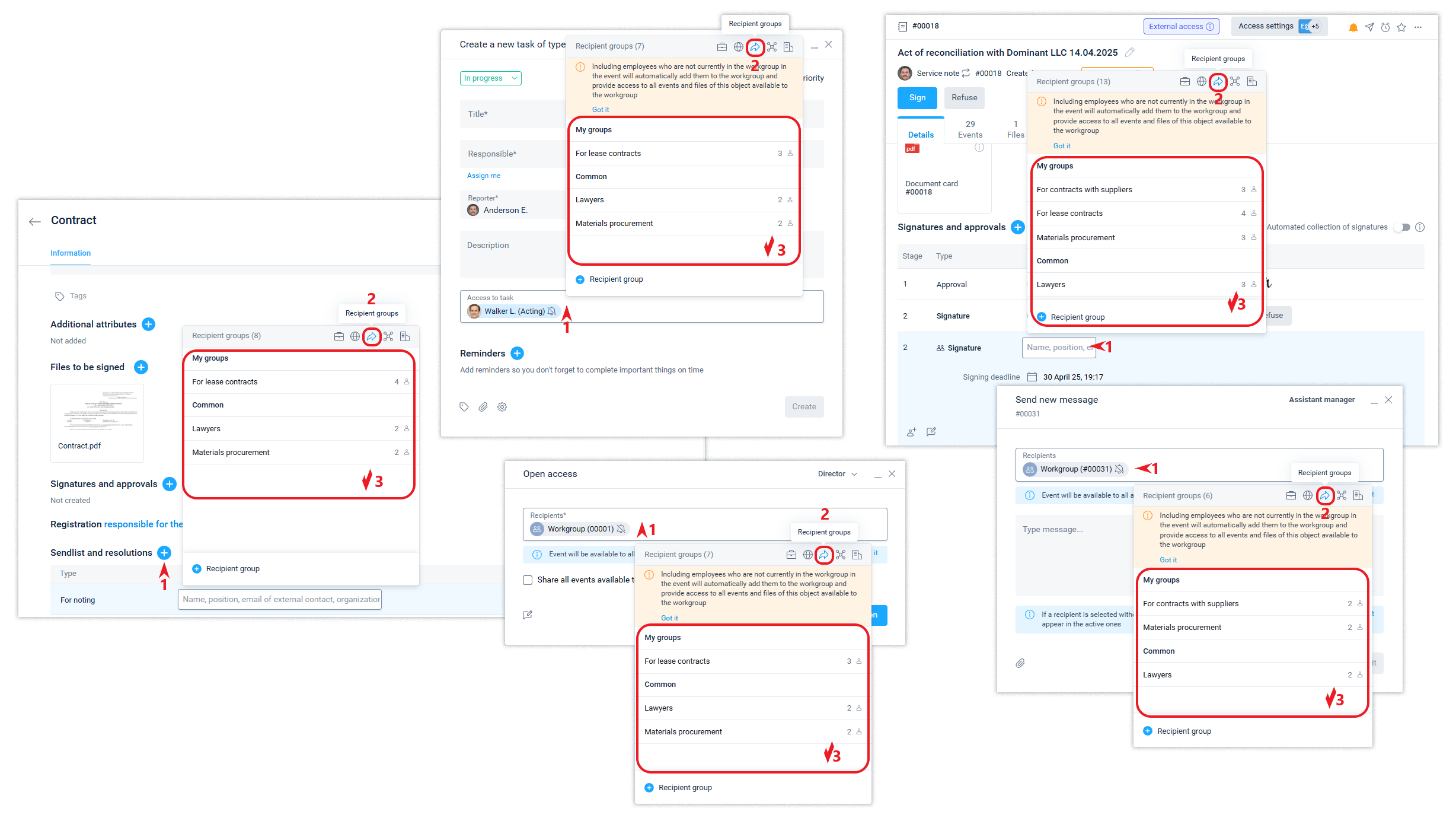
You can also create a sendlist template (recipient group) when sending a document for group signature, configuring/creating a document template, sending a message, or opening access.
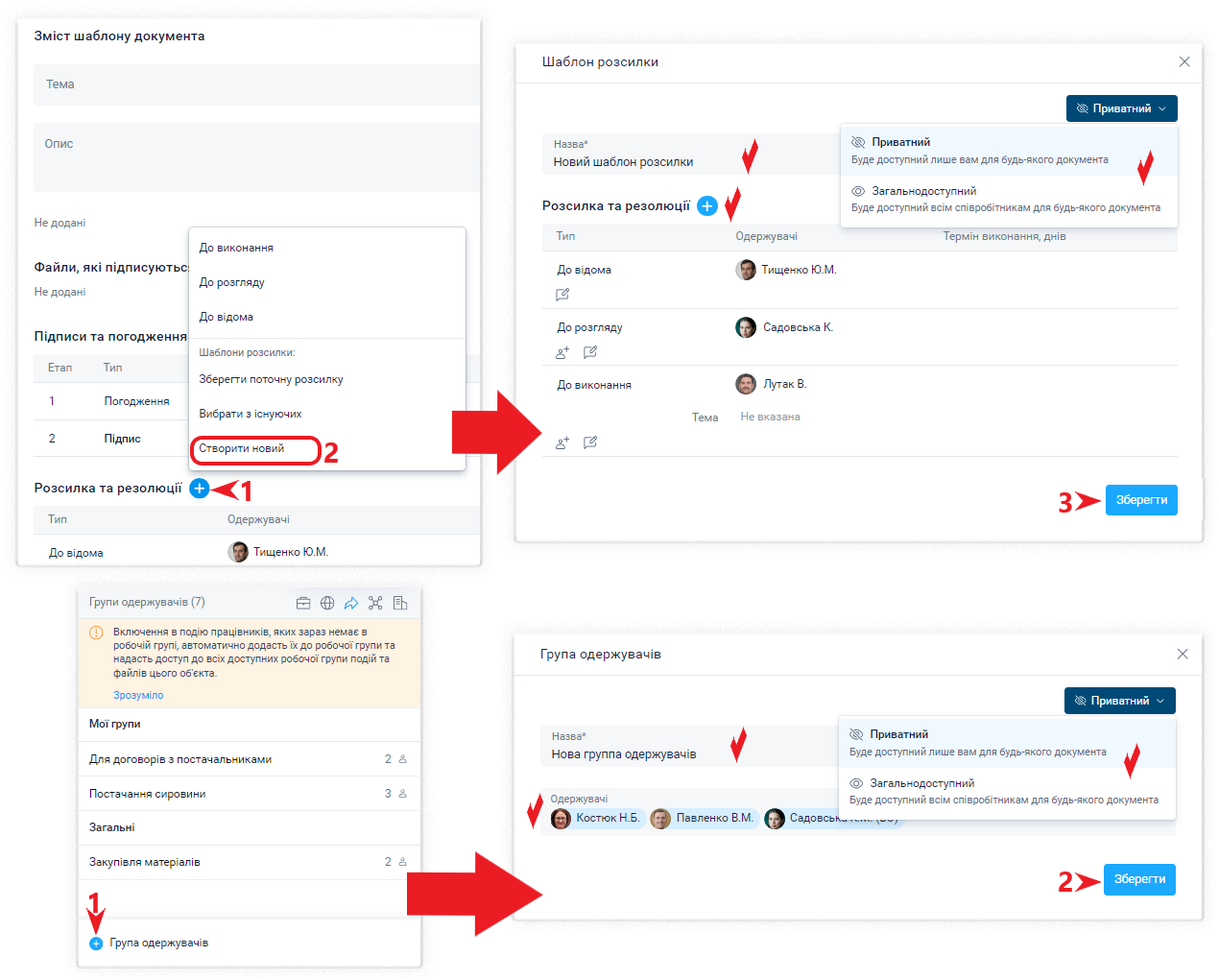
Recipient groups can include: individual positions, departments, organizations, or Public Access (via the link).